A Century After the General Strike: Class Warfare or Authoritarianism
On the Centenary of 1926 and the Erasure of Working-Class Memory

February 25 marks 103 years since Harry Leslie Smith was born. Society’s rapid decline since Covid into a gilded age for the few and penury for the many would have shocked even him, despite his predictions of collapse.
Like bankruptcy, the end of an empire happens gradually and then suddenly. Born in 1923, my father’s earliest memories were of class warfare. By 1926, his sister was dying of TB in a workhouse infirmary because the family could not afford proper healthcare. During this family tragedy, his father, a miner, joined the General Strike to fight for a living wage.
These experiences made my dad an early socialist who understood that class determines almost everything in capitalist societies. My father believed neoliberalism’s most nefarious accomplishment was persuading citizens to view themselves through the lens of consumerism rather than class. With that ideological sleight of hand, dismantling the Welfare State became as easy as stealing candy from a baby.
This May marks the centenary of the General Strike, and October marks the centenary of the miners’ defeat by the coal barons. October also marks the centenary of my father’s sister’s death in the workhouse and her burial in a pauper’s pit. Britain’s political and media classes have no plans for major commemorations or dramatic films about the strike. Our working-class history is being deliberately unremembered so that we forget our present economic and political misery is the result of deliberate policy by the governing classes.
I have kept hammering on at Harry’s Last Stand for the past seven and a half years because if neoliberalism erases ordinary working-class history and solidarity, society will be primed for authoritarianism of the worst kind—the kind that lack a black hole no light can escape from. Below is an excerpt from Harry Leslie Smith’s The Green and Pleasant Land, recalling the General Strike, whose centenary falls in May.
So much death, disease, poverty, and despair awaited me once I emerged from the birth canal in February 1923.
It was a wonder that I lived through my first night and subsequent early days because I was born scrawny and underweight — a normal occurrence for my class in 1923.
It was only Mum’s stubborn determination to see me live into adulthood that prevented me from dying before I began to walk.
The bairns from my working-class generation often died before their time from common childhood maladies.
No matter how ill I became as a boy, Mum kept the fire of life burning inside me. At eighteen months, I developed a prolapsed rectum from malnutrition that caused a portion of my intestines to slip out of my backside.
Later in life, when I questioned her erratic mothering skills, Mum roared, “You wouldn’t have been alive today if I hadn’t shoved your bowels back up your arsehole as a lad. You were a sickly bairn. But I told death to bugger off and not touch thee until ripe with age.”
Mum was not able to say the same about Marion, my eldest sister. She didn’t survive childhood.
Marion had spinal TB, which couldn’t be fixed with home remedies.
For Marion to survive, she needed care in a sanatorium — and that was beyond my parents’ fiscal resources or anyone who earned their income from the sweat of their brow.
By 1926, the TB had crushed her spine, leaving her bedridden, twisted, and in constant pain.
To ease my parents’ burden of care, Dad’s trade union donated a wicker landau for my sister. The landau had thin rubber wheels, which allowed Marion to be taken outside to enjoy Barnsley’s infrequent days of sun. When Mum pushed Marion down the street with me by her side, I would watch the wheels turn and hear their mournful squeak that sounded like cries of pity for their occupant.
Much of Marion’s time before death was spent — marooned in our dingy parlour — imprisoned on her landau.
Sometimes, I sat on the floor near my sister and told her nonsense stories that she responded to with groans of pain or with her hands thrashing about as if trying to escape her bed.
For eating, bathing, dressing, and going to the bathroom, Marion was now totally dependent on my mother’s care. It exhausted my mother and made her impatient with others — including me — because I was underfoot when Mum needed to give all her attention to my dying sister.
It was not a peaceful or comfortable year to be working-class and dying. The villages, towns, and city slums where people like my family lived were angry. They had been cheated by their political leaders who promised a “Land fit for Heroes” after the Great War in 1918.
Miners’ wages were stagnant. Many had seen their pay clawed back owing to the recession in coal prices. Other workers felt a similar pinch from their employers, who wanted more hours worked for less pay. Rent and food were unaffordable for workers. The quality of life for most was a dismal struggle.
By May 1926, the working class became militant. Britain’s trade unions called for a General Strike. It was a collective fight by organised labour to settle wage demands and working conditions for all workers.
The General Strike terrified Britain’s establishment because they feared the country was about to fall into a rabbit hole of revolution.
Winston Churchill stoked these fears. He gave speeches in Parliament depicting the strikers as communist revolutionaries out to topple democracy.
Strikers were described in newspapers as if they were insurgents or a rabble mob that wanted to storm Buckingham Palace.
Right-wing newspapers turned working-class aspirations for fair wages and affordable housing into a communist plot by Lenin to transform the United Kingdom into another Soviet Union.
The middle class accepted this propaganda as gospel. They didn’t view workers as equal to homeowners.
To them, we were an inferior species whose purpose was to serve capitalism. We were supposed to be their downstairs servants — to dig their coal or forge their steel. We were background players for their real-life silent picture extravaganza.
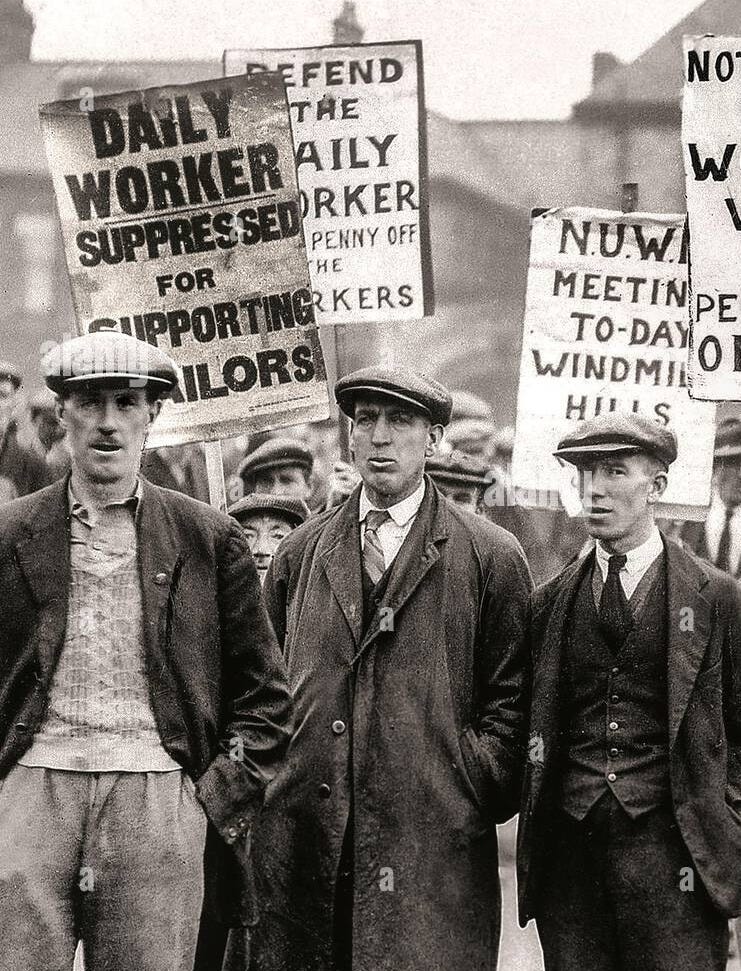
The General Strike began with militant optimism, and in less than a fortnight it was crushed by the government. Only the miners’ union refused to budge or break in the face of the intimidation thrown at them by the government and the press. While other workers returned to their employment, the miners’ union held firm with the slogan: “Not a penny off the pay, not a minute off the day.”
It was heroic but in vain that the miners held their picket line after other trade unions had been beaten into surrender. For their fight for better pay, the miners, their families, and the communities they lived in were destroyed and starved into submission by the coal barons, who refused to negotiate with the miners’ union.
The coal barons had time on their side because they had stockpiled coal before the strike as a contingency against industrial action by the miners’ union. The strikers did not have the luxury of time because strike pay was not enough for rent and food.
We had so little money during the strike that Mum took my sister Alberta and me to soup kitchens for our daily meals.
During the strike, Marion’s TB grew worse because of our limited food supply. Death was coming for her. My father and mother knew she would soon be dead.
I was told, “Play near Marion because she won’t be with us for long.”
In early autumn, the miners’ determination to continue the strike began to die. The coal barons had starved them out and broken them without mercy.
Just before the strike ended, my dad took me to one of their pickets. I do not know the reason.
It might have been as simple as not having a carer for me because my mother was busy tending to Marion. Or it might have been something more profound. Maybe Dad wanted to burn into my memory an image of working-class courage in the face of insurmountable oppression.
At the picket, Dad let me ride on his shoulders whilst he stood with his comrades to fight for fair wages and better working conditions. On Dad’s shoulders, I felt happy and safe in the company of him and his mates, who fought a fair fight for our kind.
Not long after my trip to the picket line and my triumphant ride on my father’s shoulders, the miners’ union capitulated to the coal barons. They surrendered to the owners of the pits as if they were a defeated army and were treated with no more mercy than Germany was during the drafting of the Versailles Treaty.
Miners returned to work in the pits with cut wages and increased work hours. The General Strike proved to the working class that Britain had sacrificed its young in the Great War for nothing more than to maintain and perpetuate the wealth of the few families who controlled our nation’s economy.
October 1926 was a month of incredible brutality: Marion was dying, my family was starving, and the miners’ general strike collapsed in humiliating surrender.
At the beginning of October, Mum knew she couldn’t care for Marion any longer. Death was coming hard and quick for my sister. There was nothing to be done for her at home.
Since my parents didn’t have middle-class wealth, Marion could not be taken into the care of a hospital that charged for health services. There was no alternative for Marion’s end-of-life care. She had to be committed to our local workhouse because it had a small infirmary where the working class and the indigent were provided with limited healthcare services. Generally, it was only laudanum to make one’s end of life less torturous.
In early October, Dad, with the help of a neighbour, lifted Marion — who rested on her wicker bed — onto the back of a coal wagon drawn by a lone horse. After Marion was put on the wagon, my mother climbed up to accompany her to the workhouse. The horse and wagon forlornly pulled away from our front step and moved slowly down the street towards the workhouse.
At the end of October, Marion died in a windowless room. She was ten years old. Her body was buried in a pauper’s pit. The General Strike had impoverished my father so much that he could not afford a cemetery plot for Marion.
Thank you for reading and for supporting Harry’s Last Stand. I use this Substack to preserve and promote the legacy of my father, Harry Leslie Smith, who spent the final decade of his life warning that we must not allow his past to become our future. Sadly, we have already crossed that territory. But resistance comes from remembering our working class history and using it to overcome today’s fascism.
If you’re able, please consider a paid subscription — £3.50 a month or £30 a year (converted to your currency). I’ve reduced the annual price by 20% to make it more accessible, also I have some prescriptions to pay for this month and the month is short. So rent day fast approaches.
There is also a tip jar for anyone who feels inclined.
On brighter news: The Green & Pleasant Land is now complete in beta form and with publishers. It will be published this year, and everyone who helped make it possible will be acknowledged in the book.
My father’s story — and that of his working-class generation — must be remembered if we are to resist today’s fascists. If you’d like a beta e-copy, just let me know.
Take care,
John

This is an important document of an indelible experience. My father who grew up in Birmingham slums a few years later never lost a sense of social justice even though accessing the middle class and leaving England through education post war. The contradiction between his upbringing among many families like his and his eventual individual success provided a constant need to learn more about the industrial revolution and how we became so anaesthetized to working history.
The contrast here between the scale of the general strike and Harry's daily life is very moving, and so powerful.