Chapter Thirty-Four: Keep The Effing Load Light

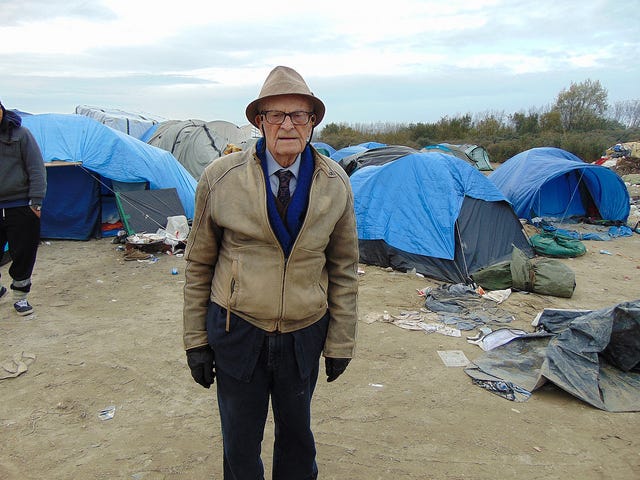
This final clean-up of The Green and Pleasant Land manuscript has had its swings and roundabouts. It’s certainly worth the effort, but it has also been emotionally exhausting. I believe Harry Leslie Smith deserves his final say from beyond the grave, helping to preserve not so much his legacy as the lives he lived before, during, and after the Welfare State.
I look forward to the day when this is finished and published, which I believe will happen this year. When the book comes out, I will celebrate by finally laying my father, mother, and brother’s earthly remains to rest. I will scatter their ashes on a lake where, long ago, we spent our summer holidays together.
The excerpt below from The Green and Pleasant Land shows Harry becoming more politicised and militarised in 1942.
It’s the end of the month, and July 1 looms before me. Things are tight, so your help is always greatly appreciated.
Chapter Thirty-Four: “Keep The Effing Load Light”
In the autumn of 1942, my unit was posted to White Waltham on the outskirts of Maidenhead. In peacetime, the airfield was a private club for millionaire aviators, and even during the war, it continued to put on airs of exclusivity.
At White Waltham, our numbers were bolstered with men from the home counties. They were mostly lower-middle-class and didn’t mix well with us northerners.
“Looks like they’ve put us in with the George Formby Brigade.”
Robbie got into a fight with one of them at breakfast after he heard “Northerners should be fed in a barn with other livestock.”
I did become friendly with one lad from the South. Clementine was different. He was the son of an Oxford grocer but wanted to become a fighter pilot. The RAF, however, considered him reckless, and his request was denied.
“Fecking RAF, said I wasn’t the right sort for flying Spitfires. Not a job for the son of a green grocer.”
There was an eccentricity in Clementine that I found intriguing and, at times, disturbing.
He took a dislike to a fellow airman who smoked a pipe, so he ground his toenail clippings and stuffed them into the man’s tobacco.
Politically, his ideology could be summed up as opportunism. His company was agreeable, but as the war progressed, his personality took odd turns, including shooting stray animals and dealing in black market goods.
At White Waltham, my unit marched from sun-up to sun-down through fields, across pasture land, and down country lanes until our bodies were numb from exhaustion by a sergeant major named Meade, who was a proper bastard.
Midway through one march, Meade stopped. He shouted for us to take a good look around at the countryside.
“Paint a picture of England inside your tiny skulls, because soon you’ll say goodbye to her. It’s war in the desert for your lot. Soon, very soon, sunshine, you’re going to be neck-deep in the shit fighting Jerry. Tomorrow, you’ll be transferred to another drill instructor. It’s time to toughen you up for desert warfare.”
Outside of a few jokes, the notion of being posted to the battlegrounds of North Africa was dismal. We knew what was happening in the Desert War from the newsreels we were forced to watch, which the RAF believed would bolster our patriotism and fighting spirit.
The following morning, Sergeant Green took command of us. At first, I thought Green would be as brutal and heartless as Meade. But his rough exterior was a pantomime for his superiors.
During our first march, Green broke routine and halted the unit in front of a cake shop.
“Right, lads, time for a brew up. If you want to buy a bun or cake, go inside the shop and get it from the lady.”
We then walked to a meadow with our cakes and brewed our tea. It seemed more of a picnic than a march, and some in the unit became boisterous.
“Steady on,” the sergeant major reprimanded. “Keep your voices down. Gather round and let me give you the lesson for today’s sermon. I don’t care much for walking, I don’t care much for marching, and I don’t care much for trouble. If anyone tries to grass me out and spoil our afternoon holidays, I’ll crucify the bastard and have their balls thrown to the camp dogs to eat.”
He paused to let us digest his words, and then continued.
“The most important rule in marching is always to keep the fucking load light.” He opened his kit bag to show us it was full of straw.
“My kit is like our leaders, filled with bloody straw. If you want to carry the weight of England on your back, so be it. If you want to get through these days lugging the least amount of shite, remember, straw isn’t just good for cows and horses. It’s good for us because it’s as light as a fucking feather.”
Off duty, we were permitted to visit Maidenhead. Maidenhead was different from the villages and cities I knew in the North because there were no slums or beggars in the streets.
On the surface, it was pretty and looked as delicate as porcelain. But the shopkeepers and townsfolk adhered to Britain’s class system with the rigidity of a Presbyterian honouring the Sabbath.
The people of Maidenhead were as sharp as barbed wire to working-class northerners.
Yet I didn’t back down from their snobbery or remove my cap to their sense of entitlement. When they were curt to me at a pub, I returned their snideness with sarcasm. The war was changing British society, and I felt empowered by my uniform. It made me bolder than brass.
At a pub in Maidenhead, I felt confident enough to chat up a barmaid despite the derision from the mates out with me. Foolishly, I took her on a date to go punting on the river, as if I were a privileged boy from the South.
I ended up tipping the punt, putting us both into the river, thrashing about like two cats in a bathtub.
On the riverbank, a fellow airman stationed at our base observed my predicament with much amusement. After initial laughter, he came over and pulled my companion and me out.
My date came out of the water, screamed at me, and stomped off.
The airman who helped us was now bent over with laughter.
“It’s not bloody funny. I had to rent that punt. Look at my uniform, it’s buggered. I’ll be up on charges if an officer sees me like this.”
“Never you mind,” he said. “I’ll help get you cleaned up and back to camp without a hitch.”
The airman helped me out, and on our way back to camp, he introduced himself.
“Jack Williams. My mates call me Taffy because I’m from Wales.”
On the long walk back to camp, we became fast friends. His family were Cardiff dock workers.
“The bosses on the docks thought my family were all communists for wanting fair wages, and maybe we are. But sod anyone who wants to keep me or my kin hungry.”
Taffy had a wonderful appreciation for poetry and introduced me to Dylan Thomas, Stephen Spender, and Auden.
“You can’t be a socialist without feeling the poetry of the working class in you,” he said.
Shortly after my visit to Maidenhead, our unit was informed we would join a mobile front-line signals regiment. Our mission: rebuild recently captured Luftwaffe airfields and make them operational for the RAF.
We were given Lee-Enfields to use for target practice.
“Jerry knows how to shoot you dead. So you’d better learn to kill him first.”
We then learned how to kill the enemy with bayonets.
“They’re animals, and we put down animals with no mercy.”
Clementine displayed a homicidal delight in bayonet practice. He destroyed and disembowelled his straw-man Nazi as if it were the real thing.
Soon after hand-to-hand combat training, my unit was taught how to toss live grenades into trenches where we were to pretend the enemy was waiting to kill us.
It was an easy task. We stood in a safe zone barricaded with sandbags. An NCO expert in munitions ordered me to stand above the parapet, pull the pin, and hurl the grenade forward into a ditch. Once thrown, I crouched behind the sandbags and waited for the explosion.
On my first attempt, I was a natural at it.
The lad who followed me was not as lucky. He hit his mark, but the grenade failed to explode when it hit the trench.
Nothing would have happened had the man stayed put. He didn’t.
The sergeant yelled, “Get the fuck back here!”
But the lad ignored the command. He jumped into the trench where his unexploded hand grenade sat. Suddenly, there was an explosion and then screams, like when I killed the pig with Bill as a boy.
The soldier lost an eye and much of his face without ever engaging the enemy.
For weeks, we forded rivers, bayoneted straw men, and tossed hand grenades until one morning on parade, a slow-moving Leyland lorry, built in 1917, pulled up beside us, steam billowing from its bonnet.
An NCO hopped from the cab and bellowed, “We have seventy-two hours to learn to drive the beast.” The ancient trucks were used for driving instruction because newer models were needed at the front by the army.
I hadn’t even learned how to use a telephone; my family were too poor. And now I was expected to master that contraption in three days.
The NCO provided vague information on how to use the clutch, accelerator, and brake. The steering column was enormous, and the lorry had no suspension. Once the beast started and lurched forward, it felt like I was in a Buster Keaton film.
The Leyland bounced from one side of the road to the other. It lurched as if it were a drunk stumbling home after last orders from the pub.
Weeks later, near Christmas, our training was completed. Yet holiday leave was cancelled. Sergeant Green said we were bound for Egypt.
“Wakey, Wakey, your school days are over. It’s time to meet Fritz.”
For me, rent day approaches like the headlights of a truck with an unsteady load on its trailer. It leaves me stuck in the middle of the road, transfixed by it, or perhaps I am too tired to react this time and jump out of its way.
The last few months have been difficult. New subscriptions have slowed, and some long-time readers have had to step away because of the cost-of-living crisis. This month alone, I lost two annual subscribers for that reason. But we plod on.
The Green and Pleasant Land is ready to be sent to my father’s old publisher for consideration. But I am stuck on the pitch, proposal and hook needed to get it from the slush pile to an editor’s eye. So, I hesitate. Moreover, I still go through and edit the book because it is so important to get this right for my Dad and his legacy.
A small independent publisher has already expressed interest in bringing it into print, which is heartening. But for my father’s legacy, and for the book itself, it makes sense to try first for the widest possible readership.
Annual subscriptions are 40% off. Nine new subscribers should put me over the top for July. My subscription rates haven’t changed since 2021: $3.50 a month or $30 a year.
Thank you, as always, for reading, sharing and supporting Harry’s Last Stand.