“I Got Out, Dad”

Sometimes memory acts like a stab wound; other times, like a paper cut.
Yesterday, seeing a photo return on my phone like a migrating bird brought happiness and sadness at the twelve years separating me from that moment. It was of my dad holding a freshly printed copy of his book Harry’s Last Stand, taken in May 2014 just before we flew to England to begin his book tour. Before the contracts were signed, the publisher had concerns about my father’s stamina and whether we were willing to foot the bill for flights from Canada to the UK.
“I am in a fine fettle and only want the opportunity to speak my piece before I am dead.”
Someone messaged me yesterday to say they had found the book in an Oxfam shop and thought the writing was beautiful.
I won’t dispute it. The writing is beautiful, although the lesson delivered between its pages is harsh. For now, it’s a forgotten book, but I hope to change that with The Green and Pleasant Land. The publisher of Harry’s Last Stand told me in 2022, “The world has moved on from Harry.”
In a way, it did. The world went from out of the frying pan of neoliberalism and into the fire of collapse.
We’ve moved on. Now we endure the worst cost-of-living crisis in modern history. The West moved on to embrace fascism and the use of blockades to starve a nation into surrender like Trump is doing with Cuba. It has moved on to classify xenophobia as patriotism. It has moved on to normalise mass death during pandemics and accept homelessness as simply the way things are. We moved into a post-truth world where facts dissolve like gravity in a Salvador Dalí painting.
Looking back at an old travel itinerary from 2014, today was the day I travelled with my father to Bradford to visit the doss his family lived in during the worst years of the Great Depression.
Below are my notes about the days leading up to the book launch of Harry’s Last Stand. They are written as a letter to my dad.
Rent day approaches quickly, and the worsening economy has cost me several paying subscribers this month. So, I have included a tip jar for those inclined to assist me in this project.
That year, at the end of May, we flew into Manchester.
It was at Ringway in 1948 that you spent your last RAF posting before demob.
The RAF sent you there as punishment for marrying Mum because marriage to foreign nationals from former belligerent powers in World War Two, although not illegal, wasn’t encouraged.
It was an attempt to demoralise you — let you know that Britain’s government might be socialist, but the RAF was not.
Your superiors gave you one task until your discharge papers came through — smash, with a sledgehammer, thousands of surplus RAF radio receivers.
So as each hammer blow destroyed hundreds of pounds worth of salvageable equipment, you tried to plot how you would provide a good life for your new wife on civvy street.
We didn’t stay long in Manchester, only one night at an airport hotel where the wait staff assumed we were on holiday.
We left the following morning and took a bus to Bradford.
On the coach, you grew pensive.
Gazing out at the rain-soaked moors as we drove down the M62, you said, “My whole life, I’ve hated buses. They only bring back memories of when my family went to Bradford after we fled Barnsley ahead of the bailiffs in 1928.”
The few days we spent in Bradford were emotionally uncomfortable for you.
You’d not been to the city since you emigrated to Canada sixty-one years earlier.
“Unlike Lot’s wife, I never looked back.”
Yet you insisted on revisiting the doss you had lived in as a boy in St Andrew’s Villas.
It was where all hope was abandoned for your family and the others who found accommodation under its merciless roof.
In the cab, over the noise of the windshield wipers, you said, “It hasn’t stopped raining over Bradford since my family came to this town in 1928.”
Standing at the front of the doss where so much hurt had occurred to your family, you wept.
After you wiped some tears away with a handkerchief, you reflected that the neighbourhood hadn’t changed much.
“It is still bleak and stinks of human suffering.”
We walked down the steep road and off into the distance.
You pointed to an off-licence and said, “At seven years old, I pushed a beer barrow up this bloody hill to earn my scratch. I did that work without a proper meal in my stomach. I laboured because no one would hire my Dad.”
Afterwards, we took a cab to Scholemoor Cemetery, where dark clouds hung heavy over a damp spring afternoon.
There you visited a field where, in times past, pits were dug, and thousands of indigent corpses were buried because the families of the dead were too poor to afford a proper funeral.
Your Dad’s remains were tossed into the ground there in October 1943.
“I got out, Dad.”
After that, you said no more.
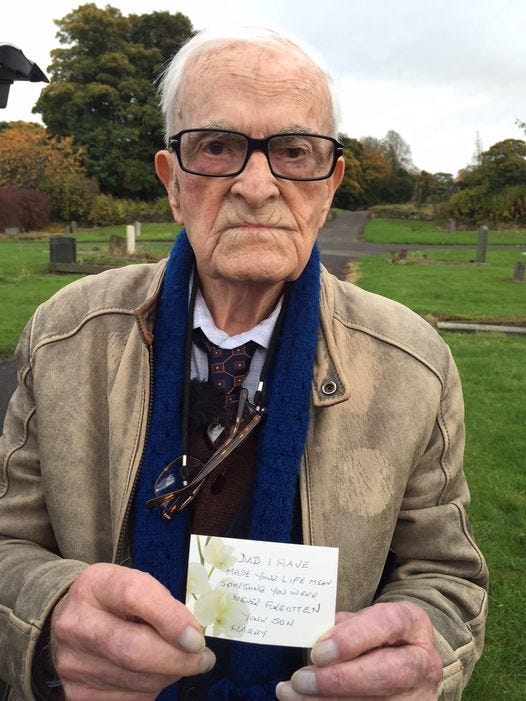
We stood silent, separated by memories you alone experienced, and I tried to interpret through the lens of a well-fed childhood.
It began to spit rain that fell as hard as pellets.
“Let’s go and get a beer; I am tired of remembering,” you said, deflated by your personal history.
A few days later, we were in London to promote Harry’s Last Stand.
We took a cab from King’s Cross to Bloomsbury and checked into a posh hotel your publisher generously booked for us.
Later, the publisher’s managing director explained that he wanted you to experience how authors were treated before corporate penny-pinching did away with book launches replete with luxuries for the talent.
“Enjoy because it will never happen again for him in this business.”
He was right.
A dinner was held in your honour at the Garrick Club the night before the publication of Harry’s Last Stand.
The guests were employees from your publishing company, your agent, the chief book buyer from Waterstones, and Bella Mackie from the Guardian, who fawned over you like an adoring grandchild.
But then again, she felt she had discovered you as she promoted your essays to the editors of the Guardian, where she then worked.
Your support for Corbyn eventually cooled her support for you, and contact during your last years trailed off.
You were politely ignored in hopes that you would change your views on Corbyn and denounce him to obtain column inches.
After you died, she wrote a loving farewell to you in the Guardian and then blocked me on social media.
That night, the Guardian published an excerpt from the book.
In real time, I watched your fame on social media grow while Amazon sales climbed to number 32 in nonfiction.
No other book of yours would ever go that high again in online sales.
When the dinner was over, we returned to our hotel room, had a nightcap, and danced together.
We believed we had established a strong beachhead, or at least, a compelling argument for society to revisit Labour’s policies of socialism from 1945.
Dancing with you that night reminded me of Christmas Eve 1987, when you, Peter, and I, drunk on port wine, danced to 1940s jazz tunes until 4 in the morning.
Thanks for reading and supporting this Substack. Without your loyalty and generosity, I don’t know where I’d be. You have certainly kept both my father’s legacy going and the wolf from my door. With four days left in May, June’s rent looks precarious.
The last few months have been difficult. Who am I kidding? Things have been difficult since cancer, Covid, and the pandemic shutting the world down. New subscriptions have slowed, and some long-time readers have had to step away because of the cost-of-living crisis.
May felt slightly more hopeful because I feel The Green & Pleasant Land can now stand on its own two feet. Hopefully, June will be more hopeful — but I have to get there first.
Also, very shortly, The Green and Pleasant Land will be sent to my dad’s old publisher for consideration. It already has a small, boutique publisher willing to print it, but to maintain his legacy, the widest possible readership is preferable.
I’m offering yearly subscriptions at 40% off. Ten new subscribers will cover much of my rent. My subscription rates haven’t changed since 2021.
It’s an SOS, but only tip or subscribe if you can. It’s an economic nightmare out there for too many of us.
Take care,
John
The world has moved on for those who’ve never read Harry’s Last stand and are determined to make his past our future John. I have a copy of the book which I haven’t read because I’m getting so familiar with his story from your Substack. I haven’t done as much as I would have liked in helping you to keep his memory alive but I may have got you a new subscriber - a friend in British Columbia was impressed by one of your original articles (not an excerpt from Harry’s work), more so when I informed her that you live in Canada now.