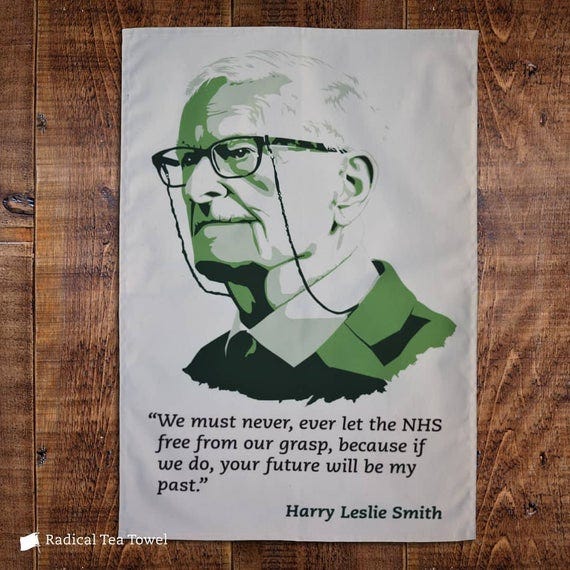
“It was a struggle.”
A working-class memory from the birth of the Welfare State

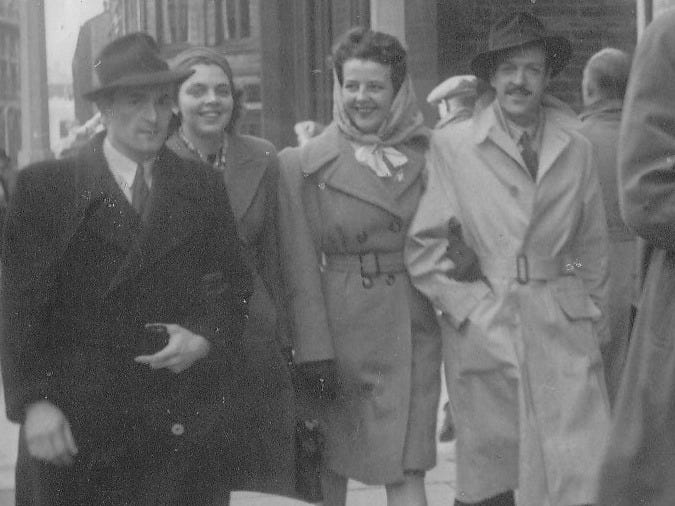
This is the opening chapter of Life on the Never, Never, the third volume of Harry Leslie Smith’s trilogy memoir cycle begun with The Green and Pleasant Land. This book chronicles life in post-war Britain, focusing on the late 1940s and early 1950s in Yorkshire.
After leaving the Allied occupation forces in Germany, Harry returned to Halifax with his German war bride, Friede. Together, they attempted to build a life in a Britain still rationed, shell-shocked, and undergoing social revolution.
Below, Harry recalls the winter of 1948. It was a moment when the optimism of Labour’s 1945 landslide election victory had curdled into austerity, disillusion, and the stark recognition that the working class would need to keep fighting for justice even in peacetime.
Told in Harry’s unmistakable working-class voice, it is unsentimental, plain-spoken, acerbic, and deeply humane. The memoir offers lived history rather than accounts shaped by establishment viewpoints or cushioned by inherited privilege.
It is a story of a nation exhausted by war, burdened by debt, and betrayed by wealthy interests that refused to yield their power. It is also a reminder of how ordinary people like Harry endured and fought to build the Welfare State and create a fairer country—one that is now fractured by neoliberalism and haunted by the resurgence of fascism across the Western world.
Love Among the Ruins was the only volume in this trilogy published during his lifetime. The Green & Pleasant Land is currently with publishers, and one has already expressed willingness to bring it to print. If you are interested in reading a beta copy, please send me a DM.
Chapter One
I was alone when the clock struck twelve and ushered in 1948. I was drunk and asleep in an empty barracks because my holiday leave from RAF Ringway was cancelled. I didn’t care much that I wasn’t in Halifax for Christmas. It meant one less argument with my mother and less spare time to fret about my future after my planned demobilisation from the Air Force in March.
On New Year’s Day, I woke early. Hungover, I cleaned myself up and ate breakfast in a nearly deserted mess hut. Afterwards, I reported to the air traffic control tower for my shift. It was uneventful because the war was long over and there were no scheduled landings for that day.
I was there in case an emergency in the skies erupted. But it didn’t. The day remained dreary, dull, deadly boring and also anxious from the hangover. It was deflated. But that was the general mood for me most days, and everyone really, for some time. Peace wasn’t living up to its expectations.
The euphoria we felt at war’s end in 1945, two years and ten months later, had lost its fizz. Plod on, plod on, do without and forgo simple pleasures like a new pair of trousers or a dress was our new reality. Peace should have been Technicolour, yet it wasn’t. Instead, there was sepia-toned grit to the days and a heavy darkness to the nights.
Happiness, for me and much of working-class Britain, was an emotion hard to obtain. Rationed like sweets, happiness came infrequently and in tiny portions.
I guess, like everyone else, I knew Attlee’s Labour government’s austerity had got into my bones. We were young, and yet our day-to-day living ached from the rheumatism of being unfulfilled. I worried what Civvy Street would be like once I left the Air Force. Jobs were plentiful, but housing was scarce.
At twenty-five, I wasn’t wet behind the ears, and I considered myself a socialist, but I was weary from the uphill battles already under my belt. I had survived a childhood of hunger, the Great Depression, and six years of war. I was Barnsley born and bred—or so my grandmother liked to boast. “Nought time, nought brass can change thee. Thou will survive all that comes in front of thy nose.”
Maybe my nan was right. Yet I didn’t want to wait for my promised land because I knew life was the briefest of dances.
At the start of 1948, I looked older than my years, but lads from the working class were always ground down, worked to death in the pits, or put into an early grave because they couldn’t afford the doctor’s fee. Blimey, some of my teeth had already begun to loosen, and others had fallen out. I worried soon I’d be growing a moustache like my father to hide my toothlessness.
Back in July 1945, it all seemed so simple. The working class sent Churchill packing when we voted for a Labour government. We put a boot up the arses of the Tory ruling classes by voting in a socialist government with a solid parliamentary majority. On your bikes, and then we rejoiced. It felt as if an era for ordinary people had begun—a new Britain where we were promised an equal share of its prosperity. Yet at the start of 1948, even with the knowledge that by summer Britain would at long last have a National Health Service free at the point of use, it felt that we had miles to go before the working class finally got its rightful share of the nation’s prosperity.
Thank you for reading and for supporting Harry’s Last Stand. I use this Substack to preserve and promote the legacy of my father, Harry Leslie Smith, who spent the final decade of his life warning that we must not allow his past to become our future. Sadly, we have already crossed that territory. But resistance comes from remembering our working-class history and using it to overcome today’s fascism.
If you’re able, please consider a paid subscription—£3.50 a month or £30 a year (converted to your currency). I’ve reduced the annual price by 20% to make it more accessible, and I have some prescriptions to pay for this month.
There is also a tip jar for anyone who feels inclined.
On brighter news: The Green & Pleasant Land is now complete in beta form and with publishers. It will be published this year, and everyone who helped make it possible will be acknowledged in the book.
My father’s story—and that of his working-class generation—must be remembered if we are to resist today’s fascists. If you’d like a beta e-copy, just let me know.
Take care,
John