Our Factory Default Setting Is Now Fight or Flight

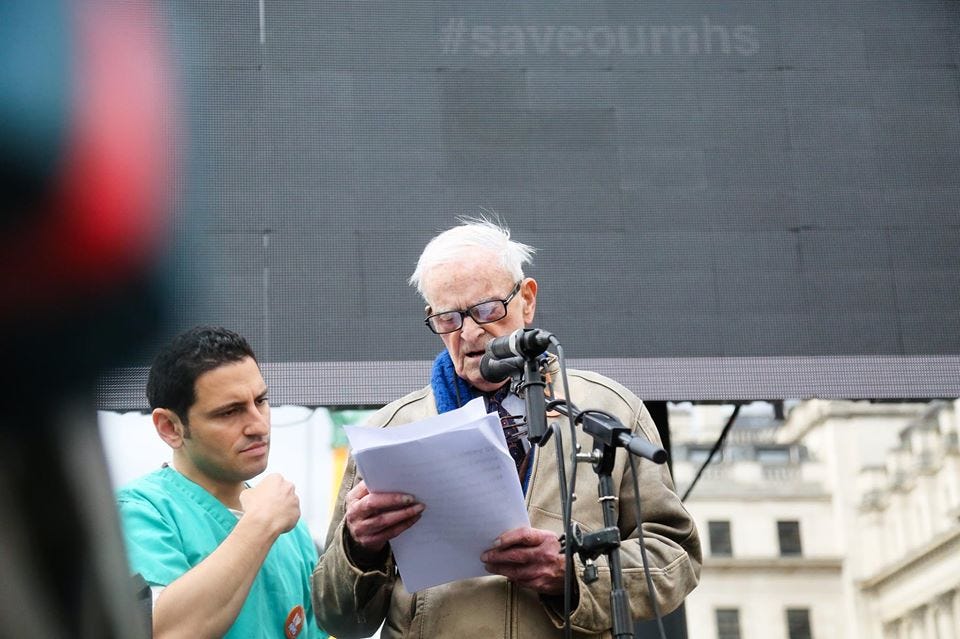
Everybody now lives in fight-or-flight mode. I am tired, you’re tired, and the people we walk past while going about our day are tired. I wouldn’t want to be young again, but I’d happily borrow their natural energy.
As I’ve written before, I’m doing a temporary gig that won’t last much longer. It involves a lot of walking because my supervisors seem convinced I have a car. So I’m covering around 19 kilometres a day, roughly 10 more than my usual average. It takes time and, by the time I get home, I’m completely knocked off my feet. Still, there’s something quietly satisfying about knowing I can still do it.
I have another excerpt from The Green & Pleasant Land for you today.
When neoliberalism hollowed out and monetised Britain, my father believed it could be rebuilt. But only if younger generations dared to break capitalism’s wheel of exploitation. “If we did it once before, we can do it again.” We should also beware of false prophets promising the end of neoliberalism whilst they remain fully embedded with in it. Andy Burnham springs to mind.
Harry’s Last Stand became my life in 2009 after my brother Pete died. It helped my father overcome the grief of losing his son, and the loss of my mother a few years earlier. After Pete died, Harry wanted to die too. He was consumed with guilt because he believed he had failed Pete. He couldn’t save him from pulmonary fibrosis as he had once helped save him from schizophrenia.
Together, we pulled the strands of his life into a story that allowed him to see what he and his working-class generation had achieved. They built something unique: a democratic social revolution without bloodshed.
I helped return his history to him. Now I want to finish what we set out to do after Pete died, so that my father’s past doesn’t become our future.
To do that, I need to remain housed. Rent is due on the 1st, and I’m still a few hundred Canadian dollars short.
If you can tip or subscribe, annual subscriptions are currently 40% off. And if you can’t, that’s all right too. If I had my way, none of this would sit behind a paywall. But the world we live in doesn’t reward the life lessons my father and his generation left behind.
Chapter Thirty-Five: Understudy to Conflict
No one told us why we didn’t deploy to Egypt at the start of the New Year in 1943. The RAF considered us inventory. A box of nails isn’t informed why it’s been sent to a shop in Leeds rather than Sheffield. If anyone asked what delayed our departure for North Africa, they got a bollocking for speaking about matters above their station. “Mind your bloody business, or my boot in your arse will send you to Egypt.”
So I, along with my unit, kept playing soldier while others did the bleeding and dying for King and country.
Air raid warnings, followed by the thuds of flak exploding in the sky above, disturbed many of our nights at White Waltham. In 1943, the Luftwaffe were out for blood. For the first time since 1941, the RAF resumed their nightly bombing runs against Berlin. It was followed up by daytime bombing by the USAAF. The ordinary citizens of the German capital were exhausted by the round-the-clock schedule of air attacks over the city. The Nazis returned the favour with Luftwaffe bombers sowing terror over London.
In our hut, the men from the South were more enraged over the bombings against London. Those from the North, like me, were less so. It wasn’t indifference to the Londoners who perished, but we knew if London was being bombed, it was unlikely our own kin up North were under bombs that night.
During my first year in the RAF, I kept most political opinions to myself. Military life was about conformity, getting along, and not becoming the black sheep. I wanted both to fit in and also not be noticed.
Living in cramped spaces during harsh economic times had taught me to stand up for myself and my needs, but also not to make myself vulnerable by expressing emotions. Feelings I hoarded and kept under lock and key in my imagination. There, they were free to roam and never be used against me.
I was lucky, because I was given more privacy than most in the RAF. As a Catholic—albeit an atheist—I was not required to attend the Sunday church parade. I used Sundays to read books and magazines and loaf.
On those quiet Sundays, I began to write prose and poetry, hiding it from my hut mates. The working class was indoctrinated to fear books, art, or any longing for beautiful things. We were taught to accept that beauty was for people better than us.
In 1943, the heavy breath of war was everywhere. But at White Waltham, I only witnessed it on newsreels. During that first year, my part in the war was like being an understudy. I learned the lines and waited in the wings as the other actors performed their duties. I didn’t know if I’d ever get my curtain call and play my role in that war of unimaginable brutality.
At White Waltham, the war reached us as rumour, gossip, or scraps from the mess hall.
“Did you hear?” A conversation would begin at tea time or when you were having a slash at the urinals. “George’s brother was taken prisoner in Africa, or the ship that Chris’s uncle was on was torpedoed in the North Atlantic, and there were no survivors.”
The war inhaled and exhaled across our consciousness. Montgomery’s 8th Army took Tripoli in January 1943. Churchill went to North Africa at the end of that month to meet Roosevelt in Casablanca. There, Britain and the USA declared that the West would accept nothing less than the unconditional surrender of Nazi Germany. It was now a fight to the finish.
The war continued with wins and losses, swings and roundabouts. But at White Waltham, my unit played pretend war games. In between drills, exercises, and marching, the men—including myself—drank beer and went on dates with local women who, like us, wanted no-strings-attached relationships, so long as condoms were used.
At the beginning of February, Stalingrad fell to the Red Army. It was a momentous accomplishment that put the Allies on the road to victory against Hitler.
A week later, our commanding officer gave new orders. The RAF wanted us to complete a mobile wireless and orientation exercise. We weren’t told at the time, but the training was meant to prepare us for the invasion of Sicily. My unit was ordered to drive across Berkshire.
During this exercise, coordinates transmitted to us in Morse code instructed us to locate designated landmarks, and when found, tap a coded message back to base. Each vehicle was given different orders and dissimilar locations to detect and report from.
The lorries were each equipped with an RCA radio transmitter, bedding, and provisions for a fortnight. A large bucket sat in the back of the truck, to be used as a lavatory. For our comfort, the bucket came with a detachable seat. And for the bashful, a canvas wrap was included. It could be erected around the bucket to protect one from the blowing winds—and from the incredulous stares of farmers as they encountered RAF men defecating in their fields, resplendent with sheep.
There were four of us in my truck: Robbie, Clementine, and a lad from Salford named Jack. I was designated chief radio operator and transcribed orders from our base, informing them nightly of our whereabouts on the road.
The convoy trundled off like the beginning of the Dakar–Paris road race. However, unlike the French rally, we were wholly ignorant of our destination or the RAF’s reason for this weird navigational foray.
It took us the better part of the day to find our first map reference. The grid location was in the middle of a church cemetery, proving our superiors were as useless as we were.
Clementine noted, “Perhaps the RAF is giving us a sign about our ultimate destination with them.”
As we were supposed to set up camp at those coordinates, Robbie and I went to the vicarage to inform the padre of our intent. It was not a promising start. The vicar greeted us, adorned in his vestments, while beside him an inhospitable dog growled. He had a long, thin, unsympathetic face.
“Permission, permission,” he grumbled, “to set up a circus tent in my church cemetery? I certainly do mind. In fact, I take umbrage at the notion. You boys think that my cemetery should be used as your lavatory? Certainly not. Goodbye, goodnight to you, and please be off this land at once. Use a farmer’s plot, use the common—but do not touch my churchyard for your shenanigans.”
By the second week, our transmitter conked out. Without radio contact, we aimlessly meandered across Berkshire, expecting someone from White Waltham to come look for us.
At times, we’d sing:
We are Fred Karno’s Army, we are the ragtime infantry.
We cannot fight, we cannot shoot, what bleeding use are we?
And when we get to Berlin, we’ll hear Hitler say,
‘Hoch, Hoch! Mein Gott, what a bloody rotten lot are the ragtime infantry.’
Running out of supplies, we returned to White Waltham unshaven, filthy, and fearful that we’d be disciplined for not completing the orientation exercise. Nobody cared, because new orders had arrived—our unit was to leave White Waltham immediately for an RAF base in Chigwell.
It was at Chigwell that news from my past in the slums of Bradford reached me. It opened old wounds and hurt me more than anything the war had yet thrown at me.
The last few months have been difficult. New subscriptions have slowed, and some long-time readers have had to step away because of the cost-of-living crisis. This month alone, I lost four annual subscribers for that reason. But we plod on.
Rent day is around 48 hours away and I am a few hundred Canadian short. So I battle towards that goal.
The Green and Pleasant Land is ready to be sent to my father’s old publisher for consideration. But I am stuck on the pitch, proposal and hook needed to get it from the slush pile to an editor’s eye. So, I hesitate. Moreover, I still go through and edit the book because it is so important to get this right for my Dad and his legacy.
A small independent publisher has already expressed interest in bringing it into print, which is heartening. But for my father’s legacy, and for the book itself, it makes sense to try first for the widest possible readership.
Annual subscriptions are 40% off. Nine new subscribers should put me over the top for July. My subscription rates haven’t changed since 2021: $3.50 a month or $30 a year.
Thank you, as always, for reading, sharing and supporting Harry’s Last Stand.