
Late last week, I became aware of the class action lawsuit against Anthropic in the United States over its harvesting of millions of books, more than a decade ago, without the permission of their authors or publishers.
Curious, I searched the database of works listed in the lawsuit. To my astonishment, I found my dad’s first book, 1923, among the titles that had allegedly been scraped.
I contacted the law firm handling the case to ask whether, as Harry Leslie Smith’s literary executor, I could file a claim for compensation. They told me that the deadline had already passed. However, they also explained that I could submit a late claim, although there was no guarantee that the adjudicator would accept it.
With that small glimmer of hope, I spent the last four days assembling the evidence and preparing the claim. I’ll be sending it later tonight.
Fingers crossed, as they say.
Another thing I need crossed fingers for is finding a publisher for The Green and Pleasant Land.
This final clean-up of the manuscript has had its swings and roundabouts. It has certainly been worth the effort, but it has also been emotionally exhausting. More than anything, I believe Harry Leslie Smith deserves one final opportunity to speak from beyond the grave, preserving not simply his own legacy but the memories of the generations who lived before, during and after the creation of the Welfare State.
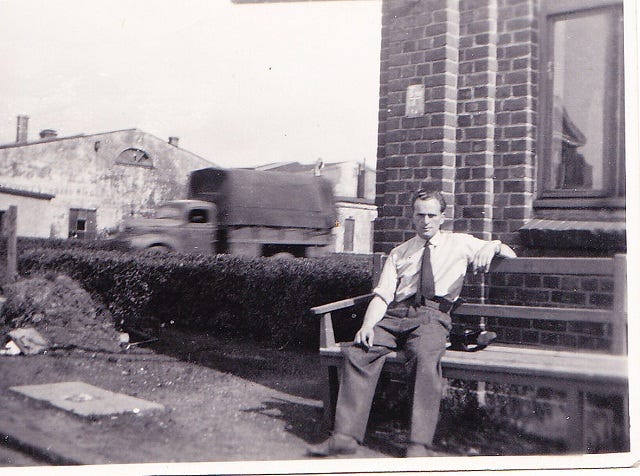
The excerpt below comes from the second volume of The Green and Pleasant Land trilogy. It finds Harry serving with the British occupation forces in Hamburg in 1945, where he begins to confront the moral ambiguities of victory.
Finally, it’s the end of the month and 1 August is fast approaching. Things are, as always, a little tight, so if you enjoy these posts and are able to support my work with a subscription or by sharing this newsletter, it really does help me make the rent. Thank you.
Chapter Two: Staying On
In 1945, I had no attachments to Britain except for one person who still tugged at my shirt-sleeves: my sister Alberta. She was my true friend and companion through our family’s bleakest and saddest moments. But my affection for her wasn’t strong enough for me to flee back into the oppressive and stifling arms of Britain’s West Riding.
Besides, Alberta didn’t have the means to put me up, even if I did want to return home. She lived on the steep hills of Low Moor, in a tiny terraced house with a young son and a troublesome husband. Nor did Alberta have any influence with the local powers to find me employment; without a friendly word in a manager’s ear, there was no possibility of a job. The mills around Bradford and Halifax were brimming with unemployed servicemen, all looking to return to their old positions. If I went home, I would be just another redundant cog in the broken wheel of British industry.
Just to make sure I wasn’t under any delusion about life back in Yorkshire, Alberta wrote to me: ‘Luv, there’s nothing here for ya. There’s nothing at all, no housing and certainly no brass. If you need it, I can always lend you a spare shilling. But I suspect you’ve got more than me being in the RAF. But I won’t deny you anything I’ve got, which is love and a shoulder to cry on. Stay put, stay safe and stay out of our Mam’s way or she’ll be asking for something from you. Enjoy your time abroad because you’ve got nowt to come home to.’
No, I wasn’t going anywhere dangerous. I would remain in Germany because they were defeated, broken and submissive. It was the safest place in the world for me to figure out what I wanted to do with my life. I knew I wasn’t cut out to live as my parents did on bread, drippings and bitter. Besides, staying on allowed me the time to pursue Friede. I wanted the opportunity to win Friede to my heart, and I believed it was going to be like most of the crooners’ love songs that played on Armed Forces Radio at the time: one that ended happily ever after.
Now that hostilities were over, the RAF had minimal expectations for the lower ranks. Their one simple rule was this: keep your head down and your nose out of other people’s business. I had no problem with this unwritten regulation as I had followed this practice since boyhood. As long as it didn’t affect my immediate well-being, the petty affairs of others didn’t rouse any interest in me. It was safer to close my eyes to everyone’s evil or saintly exploits.
After all, if I wished to remain in Germany, there was wisdom in silence. I wanted to be known and relied upon for my indifference to the comings and goings of the world around me. Keeping out of trouble was one thing; witnessing was unavoidable. Two weeks into our stay in Fuhlsbüttel, the profiteers were salivating at the opportunity to plunder an occupied country with no inventory list. Supplies, from food to fuel, were always going missing. One morning, a sergeant put a friendly arm around my shoulder after I noticed a group of airmen suspiciously hanging around a storehouse. The NCO said: ‘Lad, keep your eyes shut and whistle a friendly tune because there’s nowt to see here.’
The men I encountered were shifting boxes of tinned meats, preserves and beer into an Air Force van, which, when loaded, took off for an unknown destination. Later on, I mentioned the truck with its cargo of RAF stores to my mate Sid.
‘Oh that,’ he said. ‘It’s a sergeant’s fiddle. He’s got some deal with a bloody Nazi who owns a restaurant. The sergeant provides him booze and meat. In return, good old Fritz pays him in gold coins and jewellery.’
‘What happens to the baubles?’ I asked foolishly.
‘The missus flogs it back in Leeds.’
My mouth opened to respond, when Sid said to me: ‘Don’t even think of joining that party, mate. We should stick to what we know: getting pissed and getting laid. Everything else is a big boy’s game.’
‘Too right,’ I agreed.
So in the interest of self-preservation, I did what I was told. I turned a blind eye to my equals and my betters. I turned my back on anything that appeared out of sorts. I even closed my ears to the sound of coins being counted in the darkness by those who were plundering the German nation or the British armed forces. However, as the weeks progressed, it became more difficult to ignore the racket caused by the pilfering. It seemed anything of value, if it wasn’t guarded or nailed down, was nicked. Some members of my squad acted as if they had found bits of a Spanish galleon washed up on shore when they returned from a trip into Hamburg.
‘Jesus wept, would you get a look at that watch. It only cost me a carton of bloody Lucky Strikes.’
‘Jim, if you’d spent forty years in the pit as a ripper, you’d still not get a watch as fine as you traded today, for a bunch of bloody fags.’
With a nation being hawked away for cigarettes, I wasn’t going to be left out of this burglary. I took what wasn’t mine, but I reasoned it was an altogether different type of crime. My larceny was innocent of profit or malice. I pinched food for the German girl and her family. My misdemeanour was insignificant except to those who received my food parcels. I thought my actions were more akin to extending the hand of British philanthropy towards the less fortunate.
On base, there were a few others like me, unwilling to profit on the misery of others. We were incapable of seeing a reason to garner personal gain from the sunken and ashen faces of bomb-battered ordinary Germans. As for the rest, the temptation for theft and for sex without responsibility was overwhelming. It was too easy for them to suspend their morality while abroad. They believed that their ethics could resume upon their return to Britain. They thought their moral code was like a light switch; it could be turned on or off without ever marking their soul.
Within my barracks, a great many used food and cigarettes as a bartering device for nameless sex with near-starved German teenagers. Others traded food for gold, jewellery and other valuable commodities, which they saved for their return home to Brighton or Birmingham as chocolate soldiers on parade. Their dubious earnings from fraternising with the desperate provided a valuable addition to a down payment on a house or a new car. Others just frittered their money and morality away as if they were down at their local pub with their pay packet.
‘For a bit of coffee or nylons, you can get those Fräuleins to do anything you want.’
‘Smith, why don’t you try it, if only for a laugh? You’ll never get a chance like this again, ever in your sorry life.’
But I shook my head. I had already experienced life at the hands of ghetto kings back in Bradford and had no wish to become a proper bastard in Germany.
‘Sorry, lads, I don’t want anything from the bloody Germans because they’re nothing but trouble,’ I remarked.
Someone at the far end of our hut shouted out: ‘We got Jesus of the Nazarenes sleeping beside us. Let’s hope he doesn’t go to turning tables at the temple on Sunday.’
I laughed. ‘Bugger you, mate. There will be no water into wine for you ungrateful lot.’ I went back to reading my book.
A few days later, I spoke with my friend Taffy.
‘I wonder if things had worked out differently in the war and Jerry was on our High Street buying us out for a thruppenny, how we’d take it?’
Taffy was Welsh and as sentimental as me. I liked him for his love of poetry and whisky, and his soft touch for hard-luck stories.
‘Pack it in, Harry,’ Taffy said. ‘Most of those lads are like us; since the day they were born they’ve been beaten down by the squire, by the church, and by the foreman. All they want is to taste a bit of the good life after being cheated out of it for centuries by those Tory bastards back home. Sure, they shouldn’t be filching, whoring, and acting like clowns on parade just because no one gives a toss. But I’ll keep schtum to their misdemeanours and leave it up to God to decide who’s guilty and who’s innocent.
‘As for Ali Baba over there and his forty thick thieves, leave ’em be. Germany is a land of louts, and I’ll be glad when I am rid of it and back home in Wales. You should go home too. Forget this place; it’s filled with bloody foreigners.’
Even though it disgusted me, Taffy was right about the pilfering. So I kept quiet. I didn’t want my larceny to be revealed or curtailed, or for me to be punished for helping the German girl.
It was both terrifying and exciting keeping Friede’s family afloat while the former German nation collapsed around us like a block of condemned buildings. It was also a giant fraud because my gallantry was circumstantial. I only appeared successful and confident to Friede because her country was decimated. Every day, I was frightened that Friede would discover my counterfeit, that my ability to save her was limited to my present circumstances. Anywhere else, I would have been just one of a hundred men searching for work and shelter.
It terrified me to think that Friede or anyone else might discover that my outward confidence was a swindle, a deception as devious as a cheque written on a bank account with a nil balance. So there was no turmoil in my soul when I made an appointment with my superiors to extend my days in Germany. I had only one anxiety: that perhaps the RAF didn’t want me and were prepared to chuck me over the side once my terms of service were complete.
Before my scheduled appointment, I made sure that I was properly groomed. A German barber cut my hair and shaved me with a straight-edge razor. My uniform was pressed by a woman who worked at the base laundry. I was determined that my outward appearance would convince any officer that I was born for the military life. After a quick cigarette behind a Nissen hut, I marched over to the wing commander’s office where I was to meet with his adjutant. When I arrived, the foyer was littered with other men in similarly pressed uniforms. We looked like lackeys begging for favours in the Sun King’s antechamber. The adjutant had a wiry LAC (leading aircraftman) for a secretary, who acted more like a guard dog on an estate than an administrative clerk.
I announced myself to the secretary, who scanned a large appointment book. Out loud, he called out a roll of names pencilled in for meetings with the adjutant.
‘Benson, Hearn, Simpson... ah yes, and here we are, Smith. Your appointment is at 1:45. Bit eager, aren’t we?’ he said.
‘Pardon?’
‘You’re early for your appointment.’
‘It’s only five minutes away,’ I pointed out.
The clerk looked up at the wall clock, back to his wristwatch, and then smiled at me.
‘You’re still early. Please take a seat.’
The secretary returned to his duties, and I was left to watch the minute hand on the clock make five slow revolutions. At 1:45, the clerk stood from his desk and knocked on the officer’s door. He entered and returned to the foyer.
‘The adjutant is ready to see you.’
I stood up, and the secretary admonished me.
‘Come on now, let’s get a move on, chop, chop. We don’t have all day; the adjutant is a busy man. It’s not like going to see the parson, you know.’
The secretary announced me to Flight Lieutenant Locke, the adjutant.
‘Wireless Operator Smith to see you, sir.’
The officer was at his desk signing papers; behind him was a wall map of northern Germany. He looked up from his work and said, ‘At ease, Smith.’
He had a waxed moustache and was at least ten years older than me. It was a kind but weary face. I noticed he was wearing a wedding band. On his desk were framed photographs of a blonde-haired woman and a little girl.
He pulled open my file, read it quickly and said, ‘So you want to stay on in Germany. Any reason for this? I hope this isn’t about a girl.’
‘No, sir,’ I said. ‘I like the Air Force, and I enjoy the life. I think I can contribute to my country better in uniform than out.’
He looked back at my service record.
‘You’ve never been up on charges, and you’ve always passed your courses in the top percentiles. I’ve never heard anyone say a bad word about you. So you must be the decent sort. Well, I’m not going to deny this request. We are demobbing so many men these days, there is hardly anyone left trained to boil a kettle for tea. I’ll have your request approved.’
I saluted the officer. He returned it with a sloppy hand-to-head motion. I left the office, relieved; I had bought myself six more months with Friede.
When Taffy saw me, he asked, ‘So are you in or are you out?’
‘Back in,’ I responded.
‘Bloody fool,’ he said. ‘Everyone is begging to get out of this nut house, and you are climbing to get back in. Well, Smith, since you know you’ve got a pay packet for the next six months, let’s go out on the town and get pissed.’
💬 Thanks for Reading
Thank you for reading and supporting my Substack.
Your support helps keep me housed and allows me to keep Harry Leslie Smith’s legacy alive.
Rent day approaches like the high beams of an oncoming truck, and your support—through tips, subscriptions, restacks, or simple encouragement—helps keep me housed and continuing the preservation of Harry Leslie Smith’s legacy.
I’m $365 Canadian away from covering next month’s rent, with 3 days to go.
If you can, a paid subscription—£3.50/month or £30/year—would mean a lot. I’m also offering 40% discounts on yearly subs.
There’s also a tip jar for one-time support.
Living with cancer and lung disease makes things harder, especially during this cost-of-living crisis. Every bit of support goes a long way.
There is one line that perfectly describes so many political parties in 2026, but it so exactly describes the devil's bargain made by elected Republicans (who've all turned into quisling Magas) as well as so many corporate Democrats (who've made their peace with fascism, believing they can control the status quo):
"They thought their moral code was like a light switch, it could be turned on or off without ever marking their soul."