Substack — They Shoot Horses, Don’t They?

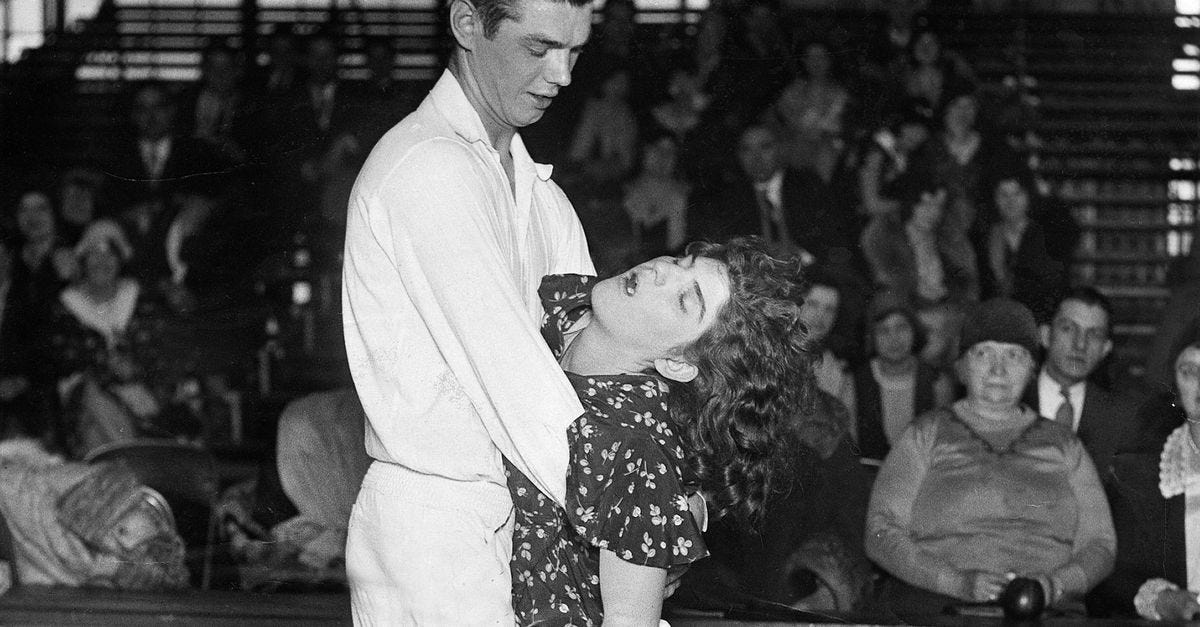
No question what we are experiencing is dystopia, and it worsens by the day. Neoliberalism requires us to believe there is a rational off-ramp from all of this — genocide in Gaza, war with Iran, the starvation blockade of Cuba, a perpetual cost-of-living crisis, the monetisation of every human interaction, and the gulagification of peaceful protest.
We are meant to believe that somewhere ahead there is a deus ex machina of good sense that will transform Trump’s stream-of-consciousness funeral oration for society into a wedding march.
I don’t see that happening, and I don’t think most of you do either.
The people who insist the system can still be reformed — politicians, corporate news journalists, and the comfortable top ten percent — all have a great deal of skin in the neoliberal game. They want us to believe that a system so metastasised with corruption and nihilism can be reformed through incremental adjustments — a tweak here, a regulation there, a slightly kinder rhetoric from the same political class that engineered the crisis in the first place.
But neoliberalism was designed precisely to eliminate the margins where people once survived.
Older social systems, for all their injustices, still contained spaces where people could subsist — extended families, strong unions, affordable housing, public institutions that functioned as buffers against catastrophe.
Neoliberalism engineered society to remove those margins. What remains are sharp edges where people perish.
The digital economy mirrors this brutal logic because the billionaires who own it didn’t want a thousand renaissances to bloom from it but instead made content creators like nineteenth-century factory workers chained to a 24/7 production cycle.
Substack is a good example. For the profit of its major shareholders it has transformed content creators into participants in something akin to a dance marathon during the Great Depression.
The 1969 film They Shoot Horses, Don’t They?, based on a 1935 novel, comes to mind. It tells the story of people trying to survive and find hope in dance marathons during a time of economic collapse. These marathons enriched the organisers far more than the participants.
I saw the movie once at the cinema with my parents when I was very young. What stayed with me was how strongly they identified with the financial desperation portrayed by the characters. They had lived it, so it was cut into them like tree rings marking drought in a forest. They also thought that because it was the 1970s the Welfare State was forever.
The rule for a 1930s dance marathon — like being a content creator for Substack or any other platform — is simple: keep producing or collapse from exhaustion. As the old saying in academia goes — publish or perish.
The result is a tidal wave of content. Most of it, mine included, is produced when it is too fresh off the vine. It doesn’t have the time or the leisure to mature in thought or style. Now I compensate for that by recycling and improving essays that were first filed under the deadline of economic necessity.
Posts by Substack creators increasingly resemble white noise in people’s inboxes. So much content is pushed out every day that it produces vast digital slush piles — newsletters that sit unopened, buried beneath newer ones, or quietly filtered into spam and junk folders.
A recent Pew Research study found that only 38 percent of subscribers actually read the newsletters they sign up for.
And who can blame them?
Content, content, content. It’s hard enough trying to keep up with your own interior monologue, let alone those from Substack creators.
Social media platforms now resemble the crowded cobbled streets of the nineteenth and early twentieth centuries — packed with the discordant cries of street mongers hawking wares that most people cannot afford or do not need.
Somehow we all became barrow boys, and I don’t think any of us intended that. But the system and its algorithms are controlled by billionaires. They control everyone’s ability to live well or not live well in a way that primitive people thought their gods controlled the wind, the sun, the weather, the tides, and a good harvest. Except in this case, unlike gods of ancient myths. The billionaires really do control everything, outside of their own mortality.
Yet even though I know the game is rigged, like in those dance marathons of the Great Depression, I keep producing, you keep producing, and everyone else keeps producing — performing, hawking bits of ourselves. We hope we are the ones who survive until the last dance so we can earn enough to enter another marathon.
However, all of us will eventually collapse under the strain of endless, breathless production. Someone else will step forward onto the digital dance floor.
After all, they shoot horses, don’t they?
Support This Work
As always, thank you for reading this far and for supporting me through this Substack. I understand how hard things are, and I am grateful to every one of you who continues to back this work despite your own pressures.
Your loyalty has helped bring The Green and Pleasant Land to completion and sustain Harry’s legacy here and across five other books. Your support allows me to continue restoring and publishing his writing — work we began together in 2010.
The Green and Pleasant Land is complete in beta form and now with publishers for consideration. I am confident it will be published this year, and those who have supported this journey will be acknowledged in the book.
March’s rent is paid, and I am grateful for that. But this work continues month to month. And, March is looking leaner than March’s in the past. If you can — and only if you can — please consider becoming a paid subscriber (currently 40% off) or leaving a tip. Ongoing support makes it possible for me to keep restoring and sharing this history.
> The billionaires really do control everything, outside of their own mortality.
And some of them are working on that. Though personally I think for their kind it can’t come soon enough.
This post hits the nail on the head.