The Hunger Winter.

Chapter Forty: The Hunger Winter
Intro
By Chapter Forty of The Green and Pleasant Land, my father’s war is drawing to a close. The Wehrmacht is in retreat, the Reich is collapsing, and the violence that shaped his young adulthood is finally running out of road. Liberation is in the air — but so too are the reckonings of total war: famine, moral collapse, vengeance, and the realisation that there can be no return to the old world. What comes next must be something altogether different.
Eighty years on, as Harry moves toward peace in his typescript, we are moving in the opposite direction. Our wars are not yet declared in the same blunt terms, but we are already living inside a deadly conflict that is accelerating towards a clash of armies, economies, and empires. Donald Trump may sit in the White House, but it is America’s ruling class that is aligned behind him — in the pursuit of new wars, new territories, and new spoils. The West will be brutalised first by conflict and then stripped of its wealth, just as Nazi Germany once plundered conquered Europe.
This chapter — The Hunger Winter — records the moment when Harry came face to face not with abstract evil, but with its consequences: starving children, collective punishment, vengeance masquerading as justice, and the understanding that returning to the old systems of government and commerce would never be enough. It is a chapter about the end of one war — and a warning to those of us standing at the threshold of another. This is made even more especially true because Gaza is enduring a Hunger Winter in 2026 because of Israel’s policy of genocide which the West endorses.
Chapter Forty: Holland 1945
The weather smelt of rain and death as my unit pushed through Belgium and into Holland during the spring of 1945. Sometimes, we stopped for a day or two to repair an airfield or hunt stray units from the Wehrmacht who had not retreated to their lines. NCOs warned us to be mindful and stay on the alert. Remnants of the Wehrmacht were operating behind our front lines as guerrilla forces. At other times, we used our training as a mobile communications unit to locate the few remaining operational Luftwaffe aircraft that still threatened ground troops. During those days, we were not at the front lines, but we were not at the rear either.
Parked at the side of the road, my eyes scanned the sky, hoping I would not spot a Stuka or a Heinkel, because I knew that if I could see them, they could see me. In the distance, the persistent thud of artillery guns mingled with the drone of aircraft heavy with bombs, destined for German forces — and the civilians caught in the crossfire.
When we were on the move, I would pull back the canvas flaps at the rear of the truck, a cigarette burning between my lips and my rifle slung across my shoulder. From there, I watched the roads that carried us closer to Germany.
In Belgium, apart from Luftwaffe attacks and V2 strikes, I never encountered a German soldier who was not already a prisoner of war. It was different in Holland.
The unit joined an enormous convoy of troops, tanks, and supplies pushing steadily towards the front.
From the back of my vehicle, a tin helmet on my head, I stared at the verges of the roads we travelled. There, I saw the steady plod of forced-labour refugees making their way towards wherever home might be. When supplies were available, cigarettes and food rations were tossed to them. Once, a new recruit on our lorry said, “It’s like feeding ducks at a pond in a park.” I told him to shut it and made a threatening motion with my gun.
In Holland, we drove through small towns that cheered us on. But amid the jubilation of liberation, a spirit of vengeance corrupted the atmosphere. People were out for revenge, and punishment was often meted out to women who had been involved romantically or socially with German soldiers during the occupation.
I witnessed mobs drag women onto wooden platforms, where their heads were shaved and their bodies doused with orange paint. The rage was medieval, and sometimes the women were beaten so badly that blood soaked the streets like rainwater pooling in a gutter.
For a week, we halted at a former Nazi airfield a few miles from the front. Before anyone could warn us that we were within range of German artillery, one of their heavy field guns opened fire on our position. I remember scurrying for cover behind a tank trap left by the retreating Germans as explosions chewed up the runway like dynamite blasting coal seams deep beneath the village of Elsecar in Yorkshire.
After the raid was over, we were ordered to sweep the base for Wehrmacht stragglers who had resisted surrender. An NCO instructed Robbie, another man, and me to enter a large hangar. If the enemy was present, the directive was clear: shoot first and ask questions later.
Sunlight flooded the dark, stale space as I pulled open the door. I advanced with my weapon raised, my heart racing and nervous perspiration soaking the shirt beneath my uniform.
To the far right, behind a stack of metal shelving, a paint tin clattered to the floor. A brown tarpaulin slithered across the concrete. Robbie and I charged forward and pinned the cloth under our boots. Two teenage boys in military uniforms wriggled free from their hiding place.
We forced them to their feet and, with my gun trained on their backs, marched them into the daylight. They were no more than fifteen or sixteen years old — the last desperate hope of the German war machine, Hitler’s child soldiers. They began to sob. I put a hand on their shoulders and tried to comfort them before handing them over to the military police, hollowed by how young they were to be wearing uniforms.
With the barracks at the airfield torched by the retreating Germans, my unit was billeted in a nearby town.
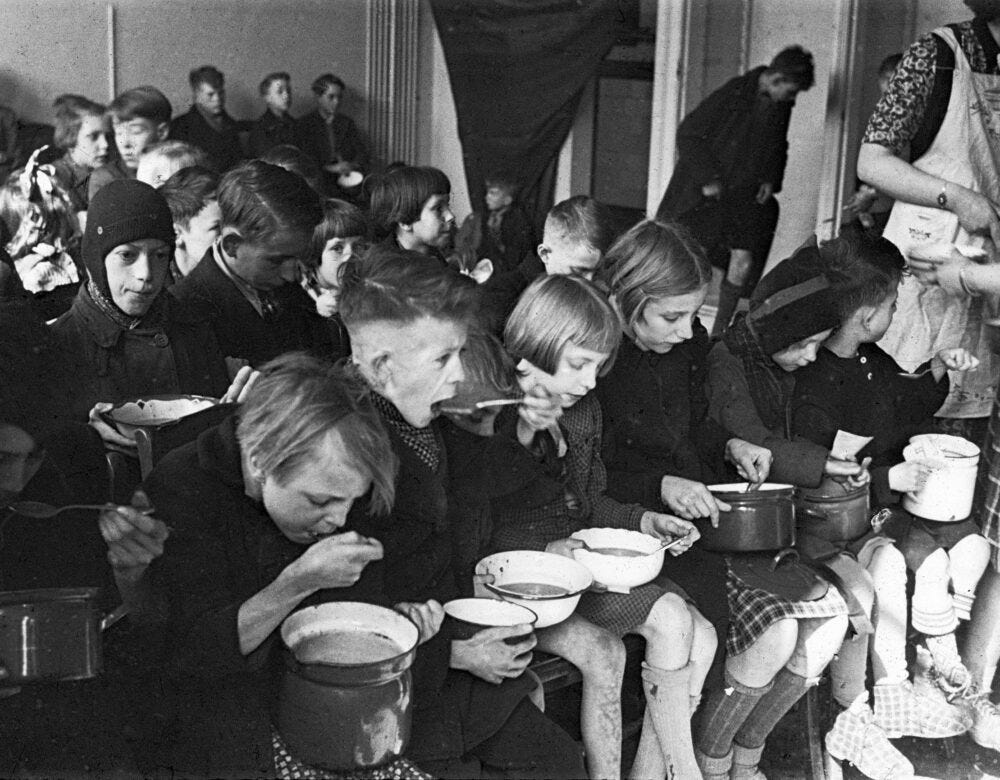
During the final months of the war, the Germans starved the Dutch partly as punishment and partly to keep their own population fed and prevent rebellion, stripping occupied territories of food. For months, the daily ration for a Dutch adult was under 600 calories — a starvation diet that caused premature death during the war and long after it ended.
In Holland, I came face to face with the full evil of Nazism. Almost every Dutch civilian we encountered was starving.
The road near our billets was lined with a forlorn procession of emaciated children, skeletons draped in skin.
We hastily erected a mess hut in an open field. Once it was ready, we gently led children and parents inside, where they were given soup and bread. The children devoured the food. We were warned by Red Cross officials not to overfeed the famished survivors of Hitler’s “Hunger Winter,” lest they die from too much nourishment too quickly. Food was provided daily for as long as we remained.
There was something almost unworldly in what the Nazis had done to the Dutch. I could not comprehend how a nation could hate another so deeply that it would starve its children. I had believed myself fluent in humanity’s cruelty towards the vulnerable, but this was beyond redemption. This was not something that could be repaired by returning to the old systems of government and commerce that had preceded the war. I felt useless in the face of so much hunger, and I felt an intense hatred for the Nazis who had inflicted it on children.
During our short stay, my unit was billeted in the deserted homes of Dutch Nazi collaborators. It was the first time in my life that I slept in a feather bed or used a bathroom adjoining my bedroom. The comforts the middle class took for granted felt alien. I thought I would sleep easily, but the more my freshly washed body settled into silk sheets on a mattress made for the well-to-do, the angrier I became — at the people and the capitalist system that had denied the working class such comforts. I thought of my mum, who had never known these things, and of neighbours in Bradford who had lived their entire lives without hot water or soft sheets.
A Dutch family lived in the house next door. I assumed that because they had not been forced to vacate their home, they had not collaborated with the Nazis. The Königs were a young, upper-middle-class family, the parents in their thirties.
The father was a portrait painter. Judging by the size of their house and its furnishings, his work must have sold well enough to support the comfortable life his family enjoyed.
Although thin, the Königs’ teenage children were not emaciated like many other Dutch youths, suggesting they had the means — or the right connections — to avoid the worst of the famine.
They were pleasant to me and the rest of the unit, likely because of our access to supplies they needed to survive. At times, they invited me for afternoon tea.
It was strange to be served tea by the wealthy. I spent time in their home learning about life under the Nazis and about painting, which Herr König was happy to discuss.
Their youngest daughter developed a crush on me, which I found flattering. Still, I had no desire for a Dutch girlfriend, though this was not the case for most Allied soldiers in those final months of the war.
I wanted no attachments. I wanted only to survive what remained of the war and return to peacetime alive and whole. Besides, there was little time for comfort: no sooner had I grown accustomed to sleeping in a feather bed than we were ordered back on the march to Germany.
Outro
Thank you for reading and for supporting Harry’s Last Stand. I use this Substack to promote and preserve the legacy of my dad, Harry Leslie Smith, who spent the final decade of his life warning that we must not allow his past to become our future. I believe we have already crossed that territory. Still, his life, his memories, his essays and speeches — and his determination to build a fairer society — remain worthy of emulation and remembrance.
If you’re able, please consider a paid subscription — £3.50 a month or £30 a year (converted to your currency). I’ve reduced the annual price by 20% to make it more accessible, and because January is a harsh month and my rent is due. I need 12 new subscriptions. A yearly subscription covers much of my essential living costs, including prescription medicines. There is also a tip jar for anyone who feels inclined.
On brighter news: The Green & Pleasant Land, after eighteen months of work, is now complete in beta format and with publishers. It will be published this year, and everyone who helped make it possible will be acknowledged in the book.
My father’s story — and that of his working-class generation — must be remembered if we are to resist today’s fascists. If you’d like a beta e-copy, let me know.
Take care,
John
Shit always rises to the surface.
As Tony Benn wrote in his diaries on one occasion of a Cabinet meeting, "Mandelson slithered in"