When History Disappears, Genocides Reappear


It’s almost lunch, and I thought I’d be farther along in my tasks for today. But I am not. My thoughts wobble at the end of the month. So, when I woke, I wasn’t sure which direction to take for today’s blog. But the news of today and the history of yesterday keep intruding on my consciousness, angering me and fuelling my anxiety.
In the West, our collective history of ordinary people is being rewritten by the entitled, through AI slop, streaming services, neo-liberal politics and the corporate news media. When history is erased, it becomes much easier for the state to disappear individuals and entire peoples. The genocide of Palestinians in Gaza and the West Bank is a case in point.
The current extermination of Palestinians by Israel is happening because the West supplies the logistics, funding and media power to normalise the genocide. As a society, we are implicated in something so heinous that it compares to the Holocaust — not in numbers but in the evil of the deed.
That is why it is little wonder that Holocaust Memorial Day, marked at the end of January to commemorate the liberation of Auschwitz — where Jews, Roma, gays, socialists, communists and Poles were murdered — has become a performative declaration to support Israel without reservation. The denial by Israel, Zionist influencer organisations and prominent individuals, as well as Western nations, to acknowledge that the Roma suffered just as much as the Jews of Europe during the Holocaust is the twenty-first century not only forgetting its history but actively rewriting it.
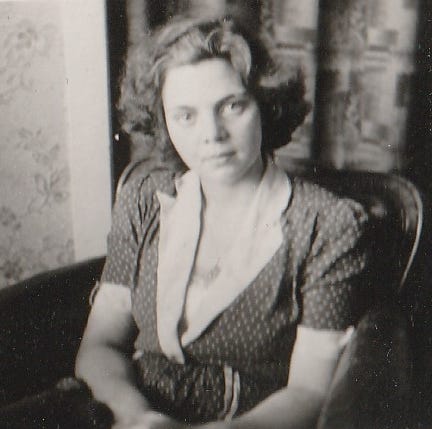
My mother was born in Germany in 1928, and both despised and adored the country of her birth. Growing up as the illegitimate daughter of a trade unionist in Nazi Germany played havoc with her personality. My mother suffered tremendous guilt throughout much of her life from being illegitimate and also feeling that she never did enough to fight the Nazis, despite being only seventeen when the war ended.
Love Among the Ruins was an attempt to describe, however imperfectly, the spirit of my mother and her relationship with my father in the first years following the defeat of Hitler.
What follows is my mother’s personal history from over eight decades ago, one that — thanks to the West’s enablement of genocide — is happening again. The twenty-first century is not only repeating history but expanding its horrors.
Excerpt from Love Among the Ruins
We stood outside her foster parents’ apartment building on Klausstrasse and I asked,
‘Shouldn’t we go in?’
‘No, not yet,’ said Friede. She then grabbed my hand and dragged me across the street and into an alleyway.
‘We still have time to see something else,’ she said and kissed me.
‘I like this part of the tour,’ I replied.
‘Harry, if you just listen to me for a moment longer, you will know more about me than any other boy I have dated.’
I grew quiet and allowed Friede to lead me further into her world. Friede said that as a very small girl, she played in the abandoned woods behind the alleyway. Being seven, she thought it was a magical place, populated with trolls, wizards, and wonderful secrets. To her, it was like the world found in Through the Looking-Glass.
The day I saw it, the spell had definitely worn off because it was now a wasteland and a dumping ground for bomb refuse. It was a much different place during Friede’s childhood. Back then, it was a wood where gypsies set up camp and lived in their painted caravans. Friede became friends with a gypsy family and played with their two children. However, when her foster mother found out about her new friendships, she was forbidden to play in the woods or associate with the gypsies. But Friede ignored her foster mother’s demand and continued to play with the children from the woods.
‘What happened?’ I asked.
‘Nothing happened to me. But later on, the Gestapo rounded them up and sent them to a concentration camp. Naturally, Mama lied to me and said, “Gypsies are like that; they are never in one place for a long time because they are nomads.” It was best to forget about them and have friendships with good German boys and girls.’
Some time after the gypsies had been taken, a neighbourhood boy found Friede playing in the abandoned wood. He asked her what she was doing there. Friede said she was looking to see if her gypsy friends had returned from their trip. The boy laughed and told her the Gestapo had arrested them.
‘How could he have witnessed that?’ I asked.
Friede answered:
‘He said he hid in the bushes and watched them being rounded up, but he was a strange and sinister boy. He warned me about playing alone here and said, “Make sure they don’t mistake you for a gypsy, or they will take you next. It will be like you never existed because everyone knows you have no mother or father.”’
Friede pulled me away from the ruined wood. We went back up through the alleyway, and she remarked that a lot of people she knew disappeared while she was growing up.
‘One day they were here, the next day gone, and no one said a word. Up the street, there was a sweetshop. It was my favourite shop. It was popular with all of the neighbourhood kids because the lady who owned it was very nice and always gave out free sweets. One day, we were told not to shop there.’
‘Why?’
‘They were Jews, and Mama said the police would give us trouble if we shopped there again. Even my doctor disappeared; he used to let me ride on the sideboard of his car as he drove to visit patients. He was really a wonderful, kind man,’ Friede said, her voice breaking.
‘As a child, it was hard for me to understand that people simply vanish from the landscape and disappear into the night. It is impossible to comprehend, especially if every adult refuses to tell you where they have all gone to.’
Friede stood on the street corner, as distant to me as a ship out at sea caught in a tempest. I went to touch her shoulder, but she shrugged off my ignorant empathy.
‘Well, well,’ she said.
‘I am seventeen, alive, and German. I feel guilty for feeling happiness. I can’t bear to think what happened to my gypsy friends. I don’t think things ended well for them, or for my doctor or for millions of other people. Let’s go; Mama and Papa will be wondering where I got to.’
Important Note:
As always, thank you for getting this far in the post and for supporting me through this Substack.
And as always, I apologise that it’s the end of the month and I am piecing together my rent, which is due in three days. I am in a bind for a few hundred dollars (CAD) and need seven new subscribers to cross that finish line. So this is an SOS.
Your support keeps me housed and allows me to continue preserving the legacy of my father, Harry Leslie Smith. Your subscriptions are not abstract encouragement — they are essential to my day-to-day survival. Like so many others, I live precariously, doing my best to stay afloat in an economy designed to wear people down.
That struggle has been made harder by cancer, lung disease, and other comorbidities, which complicate daily life in ways that are difficult to explain and impossible to ignore — especially during a cost-of-living crisis that punishes the vulnerable first.
I promise the work here is serious, relevant, and thoughtful. I believe it earns your time and, if you’re able, your support. If you can’t subscribe right now, that’s entirely understood — we are, quite literally, in the same boat.
If you’d like a beta copy of Harry’s The Green and Pleasant Land, which is now complete, send me a message and I’ll make sure you receive one.
Take care,
John
It's as if the Roma, the trade unionists, the socialists, gay people, communists have been deliberately written out of the holocaust nrrative.
I have a copy of "Love among the ruins" and thought it a great, gritty read.