"Winning, Decisively, Devastatingly and Without Mercy"

War Beneath the Bombs
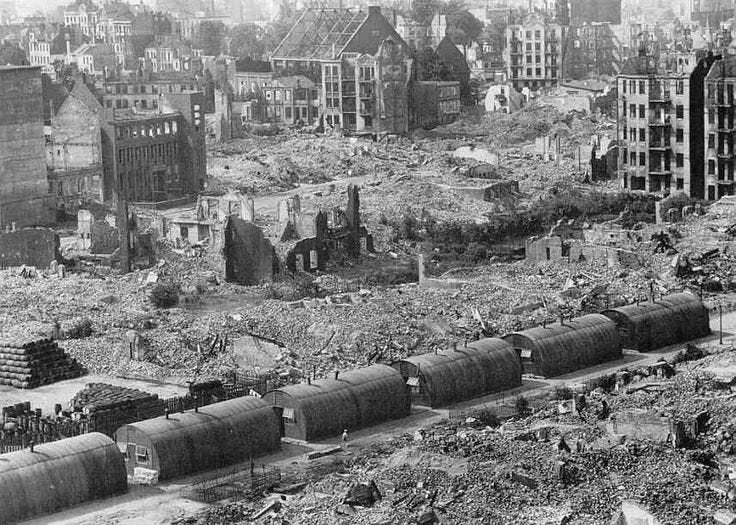
My mother was thirteen when she was badly injured during an air raid in Germany in 1941. She had been evacuated from her home city to a rural district thought to be safer from RAF bombing raids. Instead, she found herself trapped in a burning building and suffered third-degree burns across her back.
In the hospital she shared a ward with civilian casualties from the attack. In the bed beside her lay a five-year-old boy who called her Edelweiss. His leg had been shattered and had turned gangrenous. The hospital was overwhelmed with wounded civilians. Morphine and sterile bandages were already running out.
Two years later my mother was in Hamburg when Britain and America unleashed Operation Gomorrah, the firebombing campaign that killed nearly 50,000 people and destroyed much of the city in a matter of days.
When I was a small boy my mother once told me quietly:
“If your father had taken part in the bombing of Hamburg, I could never have married him.”
This week at the Pentagon, U.S. War Secretary Pete Hegseth described the bombing campaign against Iran in stark terms:
“America is winning — decisively, devastatingly and without mercy.”
War is often discussed by politicians and generals in the language of strategy and victory. But the people who live beneath the bombs experience it very differently.
Watching the images on the news, I cannot help wondering how many Iranian children have already been killed or maimed, or are dying slowly beneath the bombs dropped in our name. By us I mean the West — architects of so much destruction that I doubt much mercy will be shown when our own reckoning arrives.
In the following passage from The Green and Pleasant Land, my father arrives in London for the first time after the capital had endured three years of aerial bombardment.
Chapter Thirty-Seven
Smudge Pots and Buzz Bombs
When I arrived, London smelt of stale smoke from a recent air attack. The city was shaded in weary defiance, like a bankrupt aristocratic dowager winding down her days in a Bristol bedsit. Its inhabitants were irritable from sleepless nights caused by klaxons announcing death from above.
They weren’t the Londoners portrayed in newsreels — cheerfully defiant in the face of bombs and deprivation. The capital was bleak as winter, its buildings reduced to burnt-out skeletons. A few weeks before my arrival, 170 Londoners had been crushed to death in a panic at an air-raid shelter, mistakenly believing the Luftwaffe was overhead.
I found lodgings in a flophouse that rented beds where strangers slept side by side. It was cheap, but certainly not cheerful. Bedding with a stranger was how the working class had always travelled — since Chaucer’s time — if they had no family nearby.
My bedmate that night was a wounded airman on medical leave. The landlady told me he had nowhere else to recuperate and asked me to lend a hand if there was an air raid, as he had a broken leg. She didn’t mention that, beyond the fractured limbs, his face was badly burned. His Wellington had crashed on return from a raid over Germany, and he’d been caught in the fire when the fuel tanks exploded.
In the morning, I fetched him a cup of tea from the scullery. He thanked me. I asked, naïvely, what it was like on bombing missions over enemy territory.
“It’s a fucking nightmare, and I can’t wake up from it.”
His words stayed with me. I’d joined the RAF to escape the past, not to face the future. But in that moment, the war stopped being a rumour or a drill — it became a nightmare I hadn’t yet earned the right to wake from.
I didn’t stay another night in that doss house.
Support This Work
As always, thank you for reading this far and for supporting me through this Substack. I understand how hard things are, and I am grateful to every one of you who continues to back this work despite your own pressures.
Your loyalty has helped bring The Green and Pleasant Land to completion and sustain Harry’s legacy here and across five other books. Your support allows me to continue restoring and publishing his writing — work we began together in 2010.
The Green and Pleasant Land is complete in beta form and now with publishers for consideration. I am confident it will be published this year, and those who have supported this journey will be acknowledged in the book.
March’s rent is paid, and I am grateful for that. But this work continues month to month. If you can — and only if you can — please consider becoming a paid subscriber (currently 40% off) or leaving a tip. Ongoing support makes it possible for me to keep restoring and sharing this history.